
On 28 October 2026, Reuters reported that Telenor saw AI shopping agents as a potential challenge to its premium mobile positioning. Management expected greater price pressure, while maintaining that coverage, capacity and security could sustain differentiation. CFO Torbjørn Wist also identified agents as a possible distribution channel, provided Telenor could exchange information with them. [1]
Let us have a look at what implications this has for the BSS, and the product catalogue. If the customer delegates discovery and comparison to software (AI agents), an operator must make its value proposition accessible outside its own digital sales journey.
This is in line with what other operators are also exploring. In an April 2026 commentary, Telefónica advocated reorganizing catalogues for AI interpretation and connecting external agents to prices, inventory, delivery times and terms through APIs. Vodafone describes an Agentic Commerce innovation initiative exploring trusted, secure telecom commerce involving AI agents. These are signals of preparation and experimentation, rather than evidence that autonomous telecom purchasing is already mainstream. [2, 3] The architectural implication is significant: authoritative, semantically rich product catalogues and composable business support system capabilities become strategic infrastructure for discovery, comparison, qualification, configuration and trusted transactions.
The commercial interaction moves beyond the website
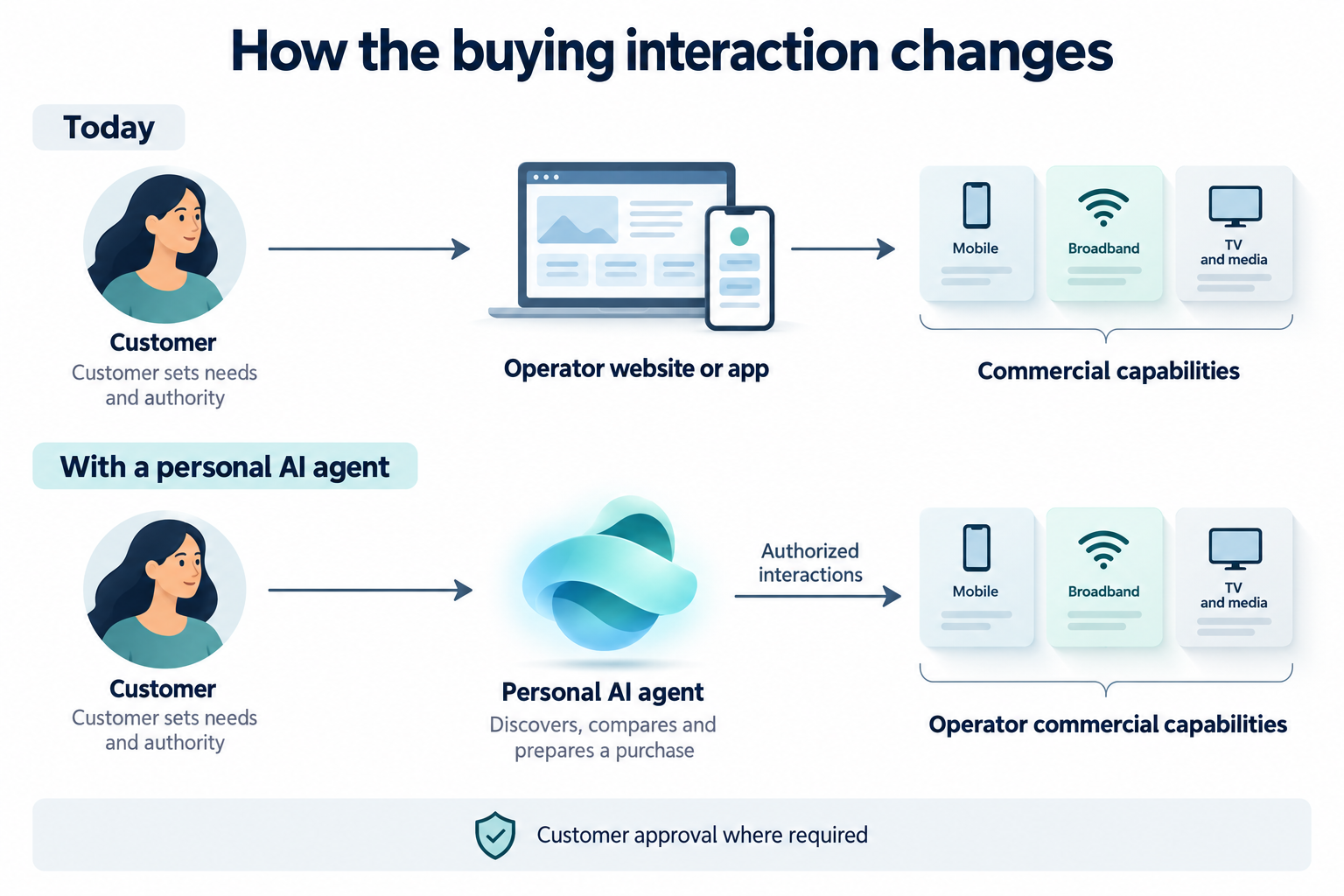
The strong focus on the UX and customer journey has made it easier for people to browse offers, configure bundles and place orders. Much of the commercial experience still assumes a person navigating a website, app or assisted sales journey. An agent acting for a household could start elsewhere: find four mobile subscriptions with reliable coverage at the family cabin, suitable roaming and security, using actual consumption metrics. It could compare providers, explain trade-offs and prepare a purchase for approval. The customer remains in charge of decisions; software performs more of the interaction.
This creates a requirement that reaches beneath the user interface or the API. An offer must be discoverable and understandable by an external participant, and the operator must provide a reliable path from a recommendation to a valid commercial commitment. A conversational front end helps only if the underlying information and capabilities can support that journey.
Differentiation must be understandable beyond price
Telenor’s concern about price pressure is credible, particularly when the accessible data reduces every offer to a monthly fee and a data allowance. But agents need not optimize only for the cheapest subscription. Their choices could reflect customer priorities such as location-specific coverage, service continuity, security, flexibility and total cost. A premium operator brand can therefore remain relevant if its value is explicit and supported by evidence. A security benefit needs a defined scope, exclusions and activation conditions. A roaming benefit needs country coverage, allowances and fair-use terms. Network-quality claims need context about location, measurement method and limitations. Advertised, estimated and contractually committed performance must remain distinguishable.
Making this information machine-readable will not guarantee favourable recommendations. It gives agents a better basis for evaluating genuine differences. Operators should make value verifiable rather than attempt to make every offer appear superior. The customer’s preferences, and the agent’s own incentives and comparison methods, will still influence the result.
Broadband exposes the full problem
Consider a customer moving home: “Find a reliable broadband connection at my new address, compare the total cost over two years and arrange installation after I approve.”
Discovery starts with available access technologies and offers. Comparison must include introductory and subsequent prices, equipment, installation charges, contract duration and relevant performance expectations. Qualification must establish serviceability at the exact address and commercial eligibility for the customer. Configuration may add mesh Wi-Fi, backup connectivity or other compatible options.
The agent then needs a current quote, a realistic installation appointment and a clear authorization step before ordering. If the appointment changes or qualification fails, the response must explain the problem and available alternatives. A catalogue entry for a 1 Gbps fiber offer cannot answer all these questions by itself.
This is where differentiated services become meaningful. A household working from home may value backup access and a defined support commitment more than a higher headline download speed. Those benefits must be represented precisely, qualified for the address and reflected in the actual quote.
Semantic product modelling makes comparison meaningful
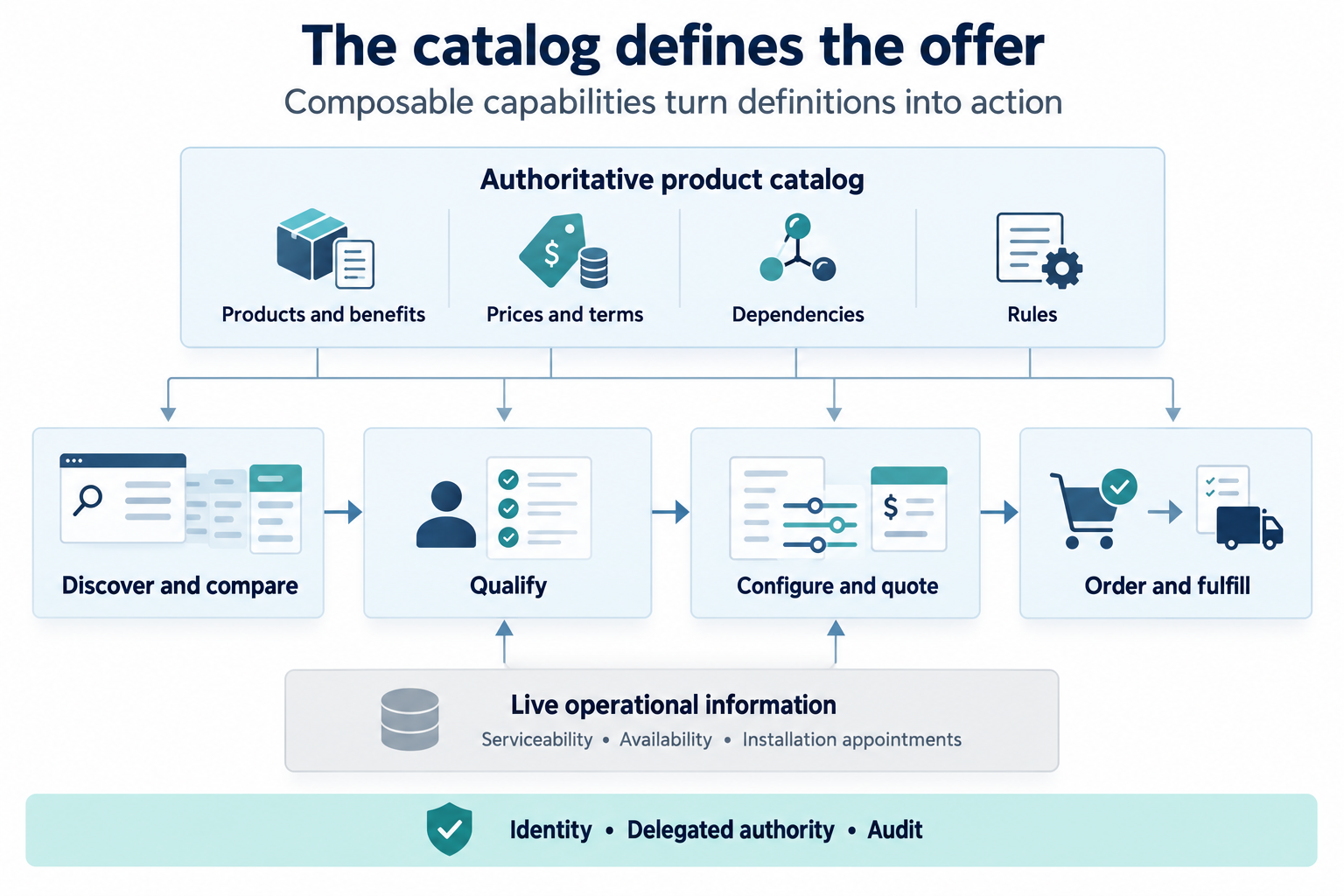
An authoritative catalogue should define what the operator sells: product specifications, marketable offerings, characteristics, benefits, prices and terms, together with dependencies, exclusions and valid combinations. Authority means clear ownership, versioning and consistency across consuming systems; it does not require every fact to reside in one database.
Structure alone is insufficient. A field called “unlimited” or “premium” has little comparative meaning without a definition. Semantic modelling makes units, scope, constraints and relationships explicit. Download and upload speeds differ; an estimate differs from a guarantee; an included entitlement differs from an activated service. Missing information should remain unknown rather than silently become a positive claim.
A shared vocabulary defines product terms consistently. An ontology can also describe how those concepts relate to one another, helping agents connect customer needs to suitable products. Comparison across operators also requires mappings between definitions and transparent handling of differences. No single vocabulary will remove every commercial ambiguity.
The catalogue should provide stable identifiers, effective dates and provenance, with links to authoritative evidence where needed. Live facts such as address serviceability, appointment availability and current customer entitlements should come from the systems responsible for them. Agents need both durable definitions and timely answers.
The catalogue defines the offer while capabilities execute it
The strategic importance of the catalogue should not turn it into a catch-all for commerce. It describes the commercial proposition and its rules. Executable capabilities determine whether that proposition can be sold in a particular context and carry the transaction through its lifecycle.
Qualification evaluates eligibility and connects to technical serviceability checks. Configuration validates combinations. Pricing and quotation calculate a contextual commercial proposal. Ordering creates and tracks the commitment, while fulfilment coordinates delivery. Product inventory records what the customer owns. Entitlement and billing capabilities determine access and charges over time.
These capabilities should reuse governed product definitions and rules, with clear responsibility for evaluating them. Duplicating logic in an agent interface recreates the inconsistencies that have already complicated digital channels. Generative models can interpret intent and explain results, but authoritative services should validate configurations, calculate binding prices and enforce transaction policy.
A robust journey also needs explicit states. A recommendation is not a quote, an accepted order is not an activated service, and a payment authorization is not evidence that a telecom subscription can be delivered. Responses should expose validity periods, errors and next actions so agents can act without guessing.
Trusted delegation requires more than recognizing an agent
Public offer discovery and access to a customer account require different permissions. Recognizing an agent does not establish whom it represents or whether it may commit that person to a recurring contract.
A practical design should verify the customer and agent, bind delegated authority to permitted actions and apply limits on spending, products and duration. Reading an account, preparing a quote, placing an order and cancelling a subscription should be separately controlled. Authority should expire and be revocable, with additional customer confirmation where the action or applicable requirements demand it.
For a transaction, retain the accepted offer and terms, the applicable authorization and an auditable record of execution. Prevent duplicate orders when requests are retried, expose reliable status and provide recovery paths when part of a journey fails. Minimize personal data shared with agents. These are proposed design requirements, to be implemented alongside applicable identity, privacy and consumer-protection obligations.
TM Forum provides a foundation for composable BSS
TM Forum’s Open Digital Architecture (ODA) provides a framework for modular, interoperable capabilities built around Open APIs. Relevant interfaces include Product Catalogue Management (TMF620), Product Offering Qualification (TMF679), Quote Management (TMF648), Product Ordering Management (TMF622) and Product Inventory Management (TMF637). [4–9]
Together, these interfaces provide useful building blocks across the commercial lifecycle. Commercial qualification still needs coordination with technical service qualification and operational systems. Configuration, fulfilment and authorization also need deliberate design; the listed APIs do not constitute a complete agent-commerce solution.
Publishing standardized endpoints does not by itself establish shared semantics, consistent rules or permission to transact. Operators must agree implementation profiles, supported versions, extensions and error behaviour, then test complete journeys. An agent-facing interface can translate emerging interaction protocols into these capabilities while retaining their controls and authoritative decisions.
The architectural objective is reusable commercial functionality beneath websites, apps, contact centres, partners and external agents. This reduces the need to rebuild commercial logic whenever a new interaction model appears.
Practical next steps
Start with one bounded journey. Choose a use case such as broadband discovery and quotation at an address. Begin with recommendations and explicit approval before introducing delegated purchasing.
Audit the commercial truth. Trace an offer from catalogue through qualification, quotation, ordering and billing. Resolve inconsistent definitions, hidden charges, duplicated rules and unclear ownership.
Make differentiation testable. Model benefits, limitations and evidence for quality, security and flexibility. Test whether an independent agent can explain why a higher-priced offer fits a particular customer.
Connect the executable capabilities. Reuse channel-independent APIs for qualification, configuration, pricing and ordering. Include live serviceability, quote validity, lifecycle status and recovery behavior.
Design delegation before enabling transactions. Define permissions, approval thresholds, revocation and audit requirements. Exercise expired authority, repeated requests and partial failures.
Measure commercial and customer outcomes. Track comparison accuracy, qualification success, quote-to-order consistency, incorrect commitments and resolution rates, alongside conversion and cost to serve.
These investments also benefit existing channels. Clearer product definitions, reusable capabilities and predictable execution improve partner integration and product agility even if agent-mediated purchasing develops gradually.
The next transformation starts beneath the interface
We do not yet know how quickly consumers will delegate telecom purchasing, or which agent ecosystems will become dominant. Operators can prepare without committing to a single prediction.
The essential question is whether a trusted agent can understand the operator’s value, determine what a customer can actually buy and complete an authorized transaction reliably. That requires an authoritative commercial model connected to executable BSS capabilities.
The operators best placed for this shift will offer genuinely differentiated services and make them easy for trusted agents to discover, compare, qualify, configure and transact. The product catalogue becomes a foundation of that commercial competitiveness, with composable APIs turning its definitions into action.
Sources
- [1] Reuters. Telenor sees AI shoppers testing its premium mobile pitch. 28 October 2026.
- Reuters report also available via Euronext
- [2] Telefónica, María Rosa López. From e-commerce to agentic commerce. 16 April 2026.
- [3] Vodafone. Inventors of Vodafone. Agentic Commerce initiative.
- [4] TM Forum. About Open Digital Architecture. Architecture overview.
- [5] TM Forum. TMF620 Product Catalog Management. Official API repository.
- [6] TM Forum. TMF679 Product Offering Qualification. Official API repository.
- [7] TM Forum. TMF648 Quote Management. Quote user guide version 5.
- [8] TM Forum. TMF622 Product Ordering Management. Official API repository.
- [9] TM Forum. TMF637 Product Inventory Management. Official API repository.