
Almost every BSS vendor now describes its platform as composable. But if replacing a product catalogue still requires a major transformation programme, how composable is it really?
In the previous Taranga article, “If Your BSS Is Composable, Prove It,” I argued that composability should be judged by the ability to change the business, not by the number of components in an architecture diagram. This article takes the next step: what should an operator actually ask a vendor to demonstrate?
The answer is not a checklist of fashionable technologies. It is a series of practical tests: who owns the business facts, what can be released independently, whether boundaries survive day-to-day delivery, how open interfaces work in practice, what replacing a component really entails, and how AI agents can act safely.
For the architectural foundation, read “Why true cloud-native architecture is the foundation for AI-native BSS”.
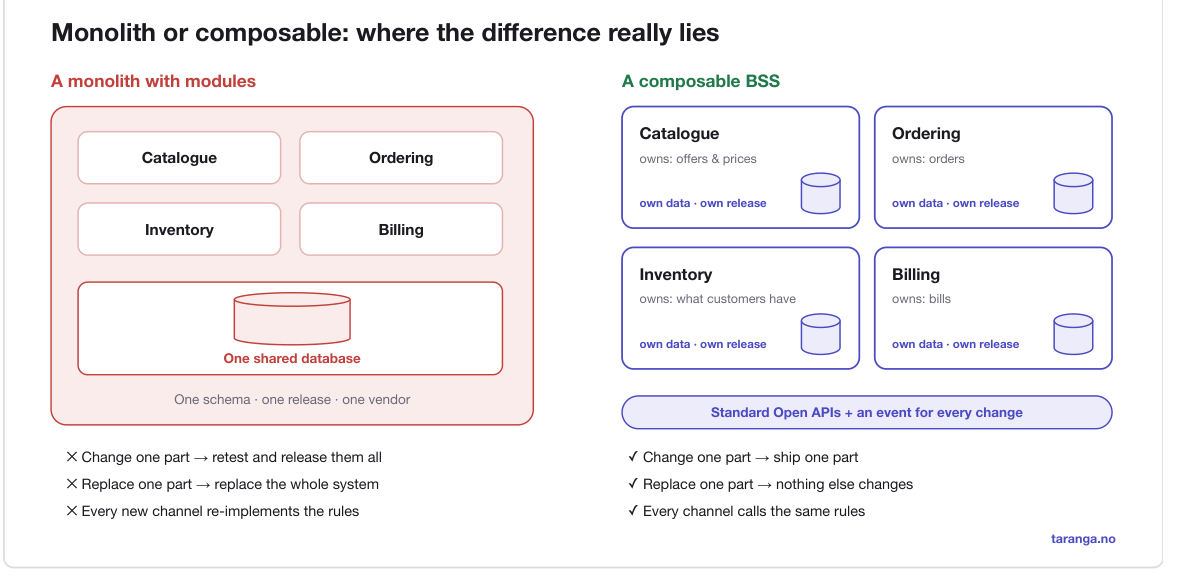
On smaller screens, scroll sideways to read the diagram. Open full-size illustration.
Read the diagram in text
Modular monolith
Catalogue, ordering, inventory and billing share a database, schema and release boundary. Changes may require coordinated testing and release.
Composable capabilities
Catalogue owns offers and prices; ordering owns orders; inventory owns what customers have; billing owns bills. Each capability controls its data and release behind stable APIs and events. Independent replacement is a design objective and still requires compatibility, migration and regression validation.
First, define what you mean by composable
A modular system divides functionality into parts. A composable system establishes meaningful business boundaries so those parts can evolve, be operated and, where appropriate, be replaced with limited impact on others. Microservices alone do not guarantee this. Nor does cloud-native deployment.
In a telecom BSS, the useful unit of design is a business capability or bounded context: product catalogue, product ordering, product inventory, billing, payments and so on. A capability may contain more than one technical service. What matters is a clear contract, a responsible owner and controlled dependencies.
Test 1 — Can you show who owns each business fact?
Ask the vendor to trace three facts: the price and eligibility of an offer, the status of an order, and the products a customer currently holds. Which capability is authoritative for each fact? Who may change it? What interface do other components use?
A robust answer identifies one authoritative owner and clear read/write rules. Other capabilities may maintain local read models for performance, but they must not quietly become competing sources of truth. Business events can distribute changes without allowing consumers to reach into an owner’s private tables.
Important distinction: Data ownership is a logical and security boundary, not a requirement for one physical database server per capability. Private tables, separate schemas or separate databases can all be valid patterns if privileges and interfaces enforce ownership. Direct cross-service queries and writes to private data undermine autonomy even when databases are physically separate.
In Taranga, business capabilities enforce data ownership through database privileges and controlled interfaces. That makes these boundaries more than an architecture convention.
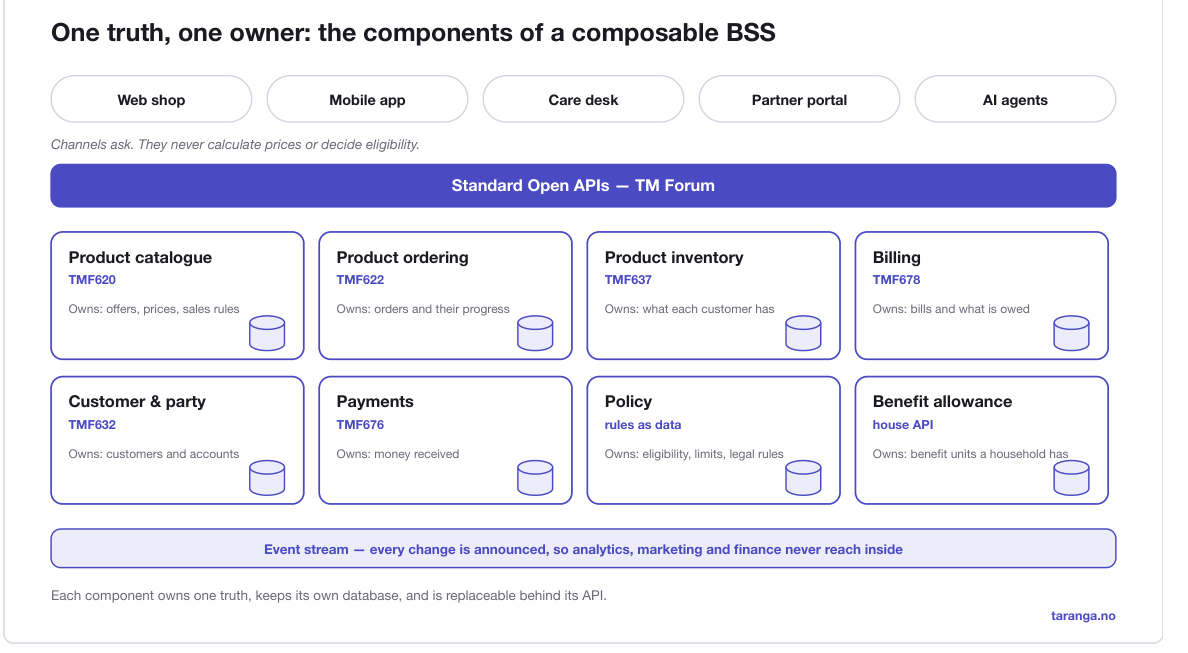
On smaller screens, scroll sideways to read the diagram. Open full-size illustration.
Read the diagram in text
Channels and contracts
Web shop, mobile app, care desk, partner portal and AI agents request authoritative decisions through APIs instead of duplicating commercial rules.
Capability ownership
The diagram shows product catalogue (TMF620), product ordering (TMF622), product inventory (TMF637), billing (TMF678), customer and party (TMF632), payments (TMF676), policy and Benefit Allowance. These are illustrative API references, not a certification claim. TMF632 is Party Management; customer and account responsibilities require their own contracts.
Protected data and events
Each capability is authoritative for its business facts. Database privileges and controlled interfaces enforce logical ownership; a separate physical database server is not required. Changes can be distributed through business events without direct access to another capability’s private tables.
Ask for proof: Show the database permissions for two capabilities, demonstrate that one cannot directly modify the other’s private data, and trace how a change is exposed through an API or event.
A real example: Benefit Allowance
When Taranga implemented a Benefit Allowance capability that lets a household select partner services within its plan, an initial design proposed six additional services. Applying the ownership test reduced the requirement to one new service. Product Catalogue already owned the products; Ordering owned the orders; Inventory owned what each household held. The missing responsibility was the allowance balance itself.
The lesson is not that fewer services are always better. It is that a composable architecture should avoid duplicating ownership. Composability is about finding the right boundaries, not maximizing the service count.
Test 2 — Can one capability evolve and deploy without the others?
Ask to see a recent production or staging release affecting only one capability. What was rebuilt? Which database migrations ran? What else had to be tested or deployed? How did older consumers behave while the new version rolled out?
Independent deployment requires contract compatibility, additive changes where possible, clear migration practices and automated contract/integration checks. Shared release trains can be an operating choice, but mandatory lockstep deployments caused by hidden dependencies are a warning sign.
Commercial rule changes offer an even stronger test. A pricing or eligibility update that is safely governed as data—with approvals and an audit trail—should not automatically require a code release. Not every rule can or should be configured, but frequently changing business parameters deserve this treatment.
Ask for proof: Change a representative commercial rule, then show the elapsed steps, approvals, tests and deployed components. The ideal is to modify the governed rule without redeploying code.
Test 3 — Do the boundaries survive real integration work?
Boundaries erode gradually: a channel duplicates a pricing rule; a reporting job reads another capability’s tables; a new partner is wired directly into the ordering flow. Each shortcut feels practical, yet together they recreate a distributed monolith.
Channels should request authoritative decisions rather than duplicate them. Payment, partner and network providers should sit behind explicit integration seams, so vendor-specific behavior does not spread through the business workflow. Permissions and tenant isolation must be enforced at appropriate service and data boundaries—not merely at the website front door.
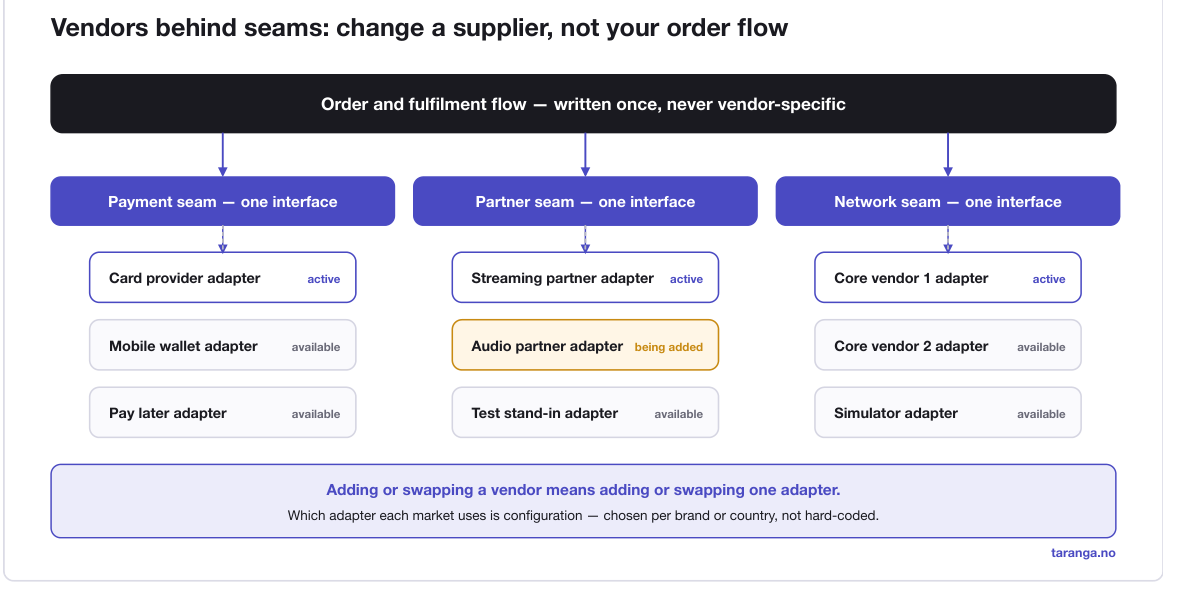
On smaller screens, scroll sideways to read the diagram. Open full-size illustration.
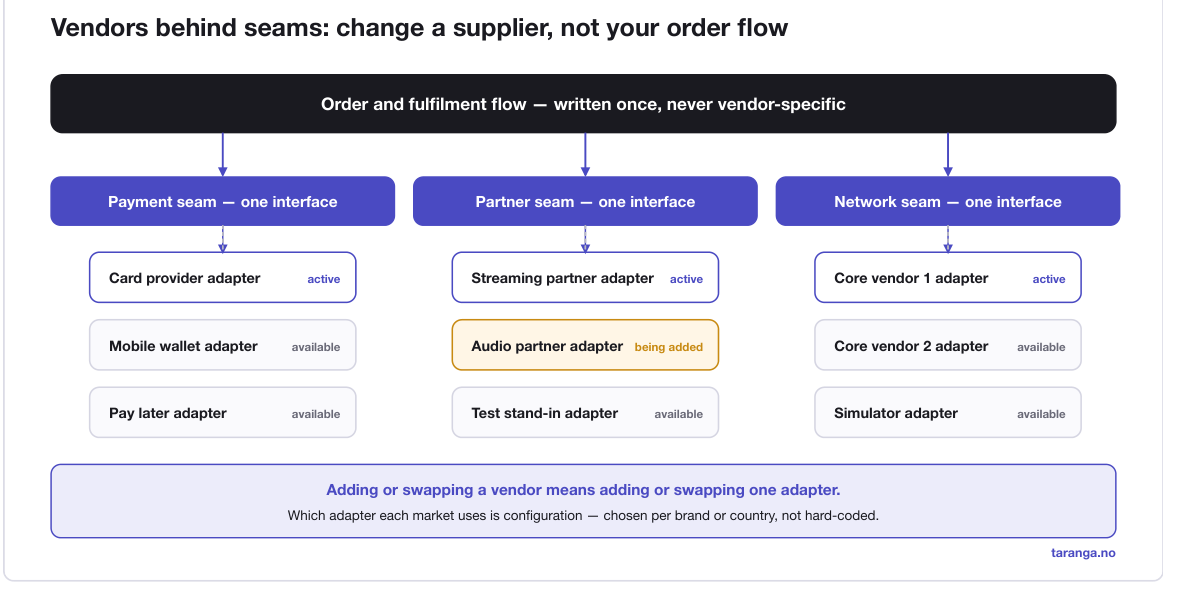
Read the diagram in text
Stable workflow and integration seams
The order and fulfilment flow connects through payment, partner and network interfaces. Each interface contains supplier-specific behavior in an adapter.
Illustrative adapters
Payment examples include card, mobile wallet and pay-later adapters; partner examples include streaming, audio and test adapters; network examples include core vendors and a simulator. Labels such as active and available illustrate the design, not production availability.
Changing suppliers
Choose an adapter through deployment configuration while preserving the business-facing contract. Adapter changes still need testing and operational validation.
Ask for proof: Show what code changes when a payment provider or network adapter is replaced. Then show the architectural checks that prevent direct cross-capability database access or channel-specific duplication of critical business rules.
Test 4 — Do standards reduce integration effort in practice?
TM Forum Open Digital Architecture and Open APIs provide a valuable common vocabulary and interface framework. APIs such as TMF620 for product catalogue, TMF622 for ordering and TMF637 for product inventory can help operators reduce bespoke integration.
But the same API identifier does not automatically imply plug-and-play replacement. Versions, optional fields, extensions, semantic interpretation, process behavior and operational requirements can differ. Conformance tests are useful evidence of API alignment, not proof that two components are interchangeable in every deployment.
Ask for proof: Which API versions and operations are implemented? Which conformance results can be demonstrated? Where are vendor-specific extensions mapped? Can a second implementation run against the same consumer contract and test suite?
Test 5 — Can you replace one component without rebuilding the surrounding landscape?
The strongest demonstration is not a greenfield deployment. It is replacing an existing capability while the rest of the business continues to operate.
Imagine replacing Product Catalogue. Keep the consuming channels and ordering workflows behind a stable contract. Migrate relevant product data; compare responses from the incumbent and replacement; validate compatibility and cut over in controlled stages. A rollback plan, operational readiness and reconciliation are as important as the API interface.
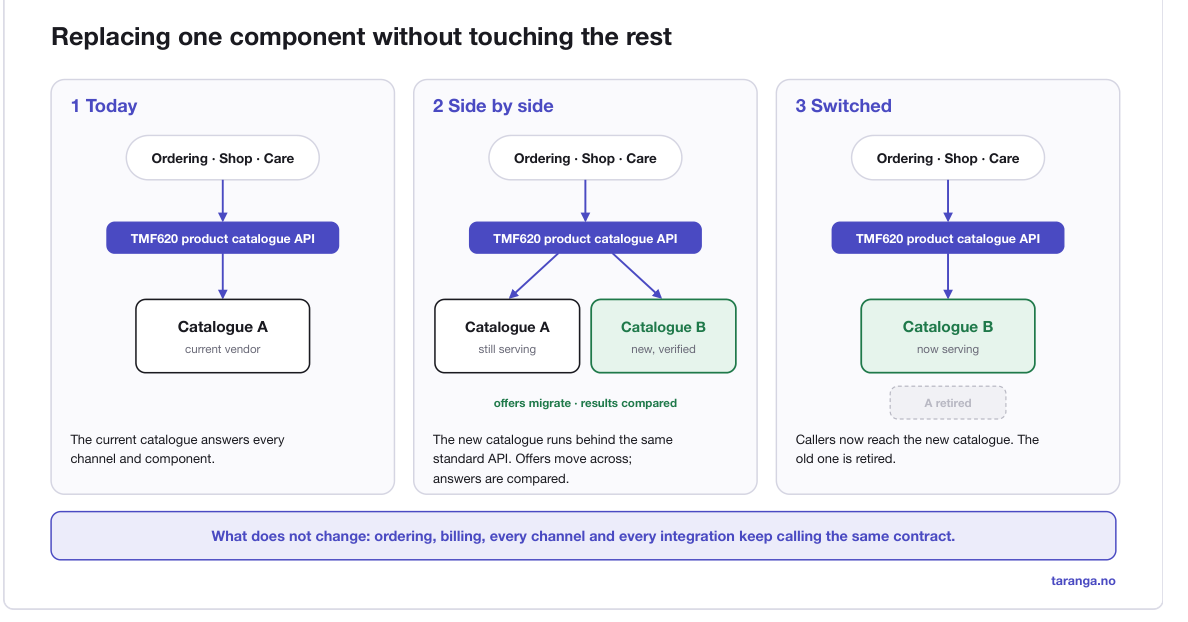
On smaller screens, scroll sideways to read the diagram. Open full-size illustration.
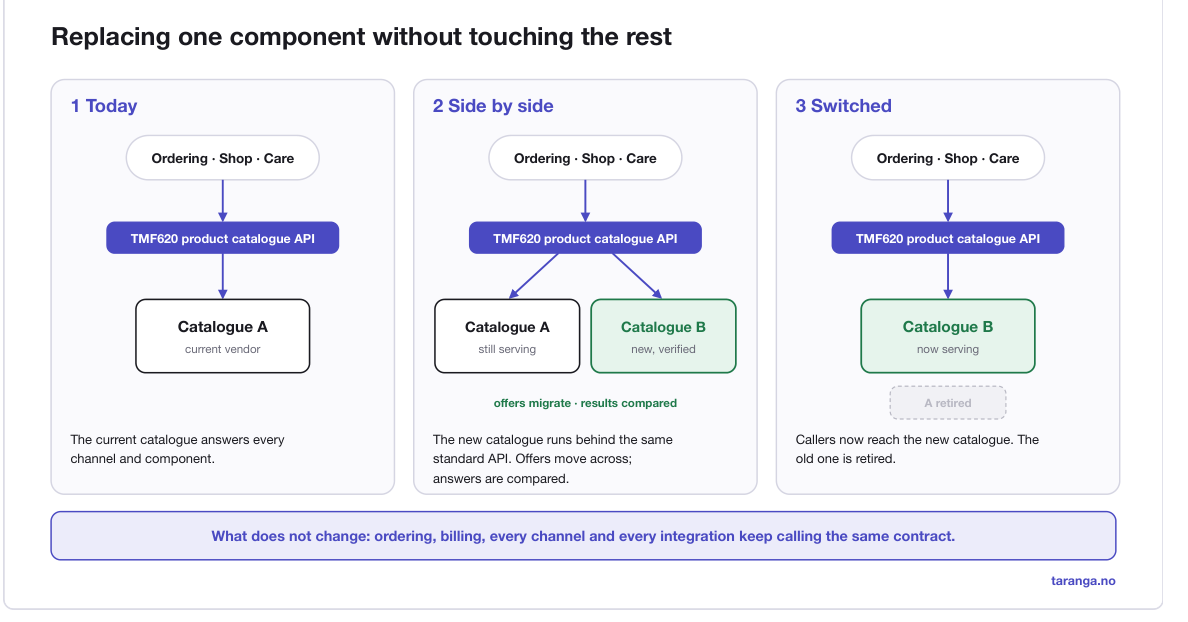
Read the diagram in text
Today
Ordering, shop and care use Catalogue A through a product catalogue API represented by TMF620.
Side by side
Catalogue A continues serving while Catalogue B is verified. Migrate offers and compare results against the same consumer contract.
Controlled cutover
Direct callers to Catalogue B and retire A after compatibility, reconciliation, rollback and operational checks. Stable contracts aim to limit caller changes; data migration, semantics, testing and cutover remain engineering work.
Composability does not make this work disappear. It contains its scope. The operator should not have to redesign billing, every sales channel and the order journey merely because the catalogue supplier changes.
Ask for proof: Run a time-boxed replacement exercise with a representative data set and real business scenarios. Report exactly which consuming components, adapters, rules and processes needed modification.
Test 6 — Can AI agents act through governed business capabilities?
AI-native BSS requires more than a conversational interface over legacy data. An agent helping a customer compare subscriptions or change a plan must discover valid offers, evaluate eligibility, understand financial consequences, request an authorized action and record the outcome.
An appropriate design exposes business actions through clearly defined APIs and policy checks. Agent identity, delegated authority, customer consent, limits, approval requirements and audit evidence matter. Humans should approve consequential actions when the risk, regulation or delegated authority requires it; explicitly authorized low-risk actions need not all be manually approved.
A monolithic system can also enforce sound governance. The advantage of clear composable boundaries is that governance can be applied consistently to explicit capabilities and evolve without duplicating control logic across channels.
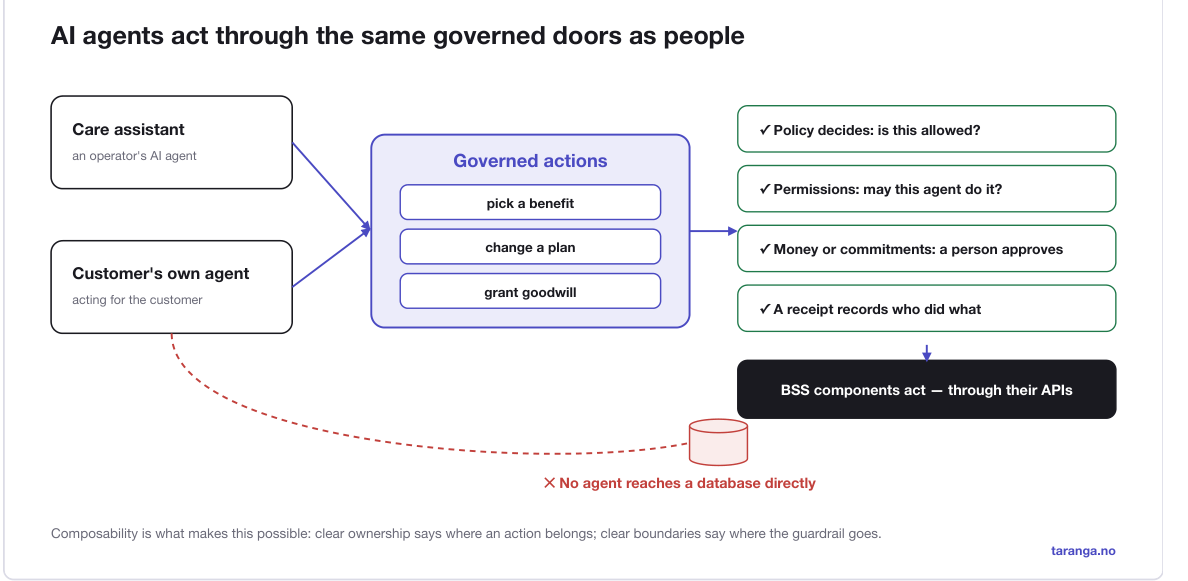
On smaller screens, scroll sideways to read the diagram. Open full-size illustration.
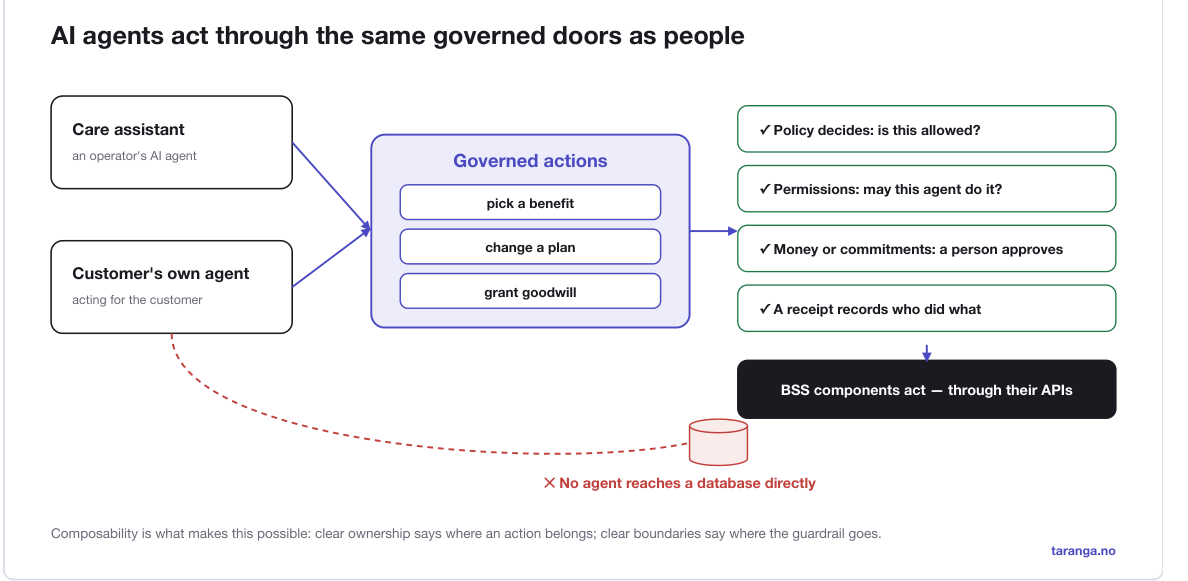
Read the diagram in text
Agents and business actions
An operator’s care assistant and a customer’s own agent can request actions such as picking a benefit, changing a plan or granting goodwill.
Governance checks
Check policy and agent permissions, apply approval where risk, regulation or delegated authority requires it, and record who requested and executed the action. Explicitly authorized low-risk actions need not all be manually approved.
Execution boundary
BSS capabilities execute through their APIs. Agents must not bypass business policy by accessing private databases directly. A monolithic system can also enforce sound governance.
Ask for proof: Demonstrate an agent-initiated plan change: its authority check, business-rule evaluation, any required approval, execution outcome and traceable decision/action record.
What operators should take away
The best question is not “How many microservices do you have?” It is “Show me what happens when I change one part of the business.” Six observable tests turn composability from a marketing adjective into a practical evaluation discipline.
A well-designed BSS should enable small teams to own capabilities end to end, let operators modernize incrementally, reduce avoidable vendor dependence and offer AI systems safe ways to interact with commercial functions. None of this removes integration, migration or governance work. It makes that work more bounded, testable and manageable.
At Taranga, we are building around these principles: clearly owned business capabilities, protected data boundaries, TM Forum ODA/Open API alignment and governed AI interactions. The Benefit Allowance implementation illustrates how disciplined ownership decisions can reduce unnecessary complexity.
If your team is assessing a BSS platform, ask its vendor—including us—to demonstrate these tests against real scenarios, not just architecture diagrams.
Related reading
Taranga Insights — Why True Cloud-Native Architecture Is the Foundation for AI-Native BSS
Taranga Insights — If Your BSS Is Composable, Prove It
Sources
- TM Forum — Open API directory: representative product catalogue, ordering and inventory APIs
- TM Forum — About Open Digital Architecture
Related articles
Why true cloud-native architecture is the foundation for AI-native BSS
As BSS messaging shifts from cloud-native to AI-native, the architectural distinction matters. Running in the cloud is not enough: independent change, automation and resilient operations provide the foundation for continuously evolving AI-native BSS.
Read article →If Your BSS Is Composable, Prove It.
Why cloud-native architecture is not enough — and why true composability matters for AI-native telecom.
Read article →