
Almost every BSS vendor claims to offer a composable platform. But if replacing a single component still requires a major transformation project, how composable is it really?
That is the question I believe operators should be asking. Not how many modules a vendor can show on an architecture slide, but what actually happens when the business wants to change just one part of the system.
In my previous article, “Why True Cloud-Native Architecture Is the Foundation for AI-Native BSS”, I argued that moving BSS software to the cloud does not make it cloud-native. The same distinction applies here: dividing a platform into modules — or even microservices — does not automatically make it composable.
Modular on paper. Tightly coupled in practice.
Most established BSS platforms have recognizable components: catalogue, ordering, inventory, charging and billing. Yet an attempt to replace the catalogue may still affect ordering flows, pricing logic, customer channels, integrations and the release plan for the entire estate.
The root issue is not the number of boxes in the diagram. It is the dependencies hidden between them. Shared data models, duplicated rules, coordinated releases and vendor-specific interfaces can make nominally separate components behave like one system.
A practical definition of composability is demanding: a business capability can be changed, extended or replaced behind a stable contract without forcing unrelated capabilities to change. That does not mean replacement is effortless; data migration, process compatibility and operating requirements still matter. But the surrounding systems should not need to be redesigned.
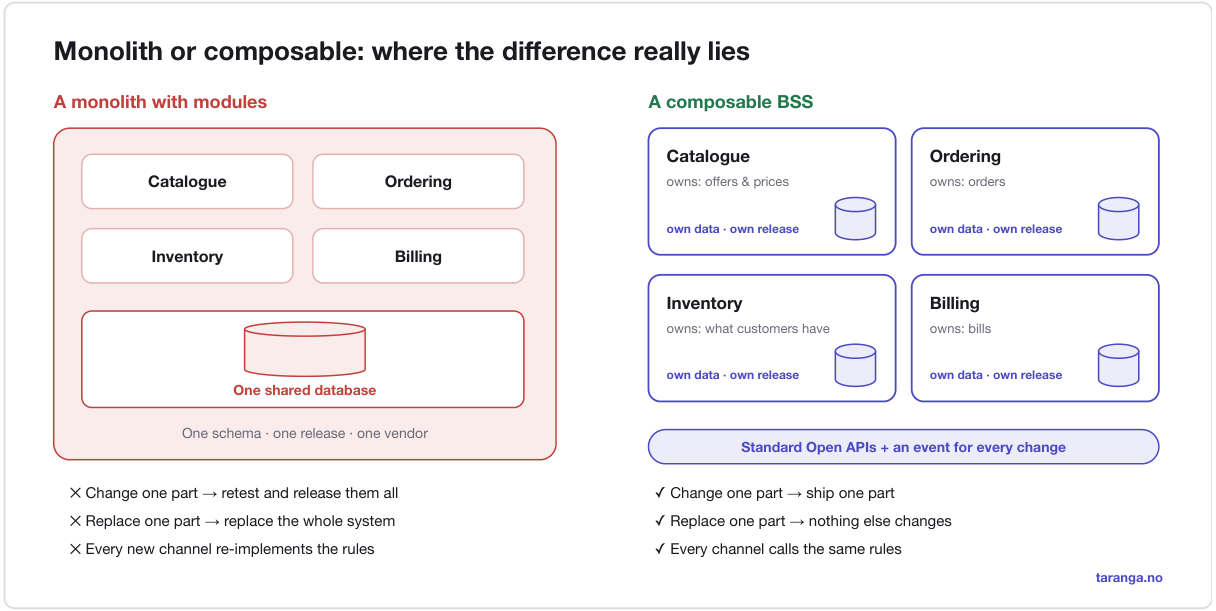
On smaller screens, scroll sideways to read the diagram. Open full-size illustration.
Read the diagram in text
A monolith with modules
Catalogue, Ordering, Inventory and Billing share one database. One schema · one release · one vendor.
- Change one part → retest and release them all
- Replace one part → replace the whole system
- Every new channel re-implements the rules
A composable BSS
Catalogue owns offers and prices; Ordering owns orders; Inventory owns what customers have; Billing owns bills. Each has its own data and release. Standard Open APIs + an event for every change.
- Change one part → ship one part
- Replace one part → nothing else changes
- Every channel calls the same rules
Why executives should care
Composability is not an architecture trophy. It is an economic and organizational advantage. If a new offer, partner bundle or pricing model requires months of cross-platform development, technology is constraining commercial ambition.
A composable BSS should make smaller, lower-risk changes possible. Teams can bring a new capability into a limited market or segment, measure results and expand it without replacing the entire commercial core. An operator gains flexibility over suppliers and can modernize selectively rather than repeatedly funding large replacement programmes.
This connects directly to another lesson from BSS transformation: small, empowered teams outperform large coordination structures only when they can actually deliver independently. Small teams cannot move independently if the systems they own cannot change independently.
Open APIs are necessary. They are not the proof.
TM Forum Open Digital Architecture and Open APIs offer an important common language for capabilities such as catalogue, ordering and inventory. They can help operators avoid bespoke, vendor-specific integration at every boundary.
But an API label is not proof of genuine interchangeability. Two components may expose the same endpoint while interpreting products, states or business rules differently. The difficult work often lies in semantics, data ownership, orchestration and backward compatibility.
Operators should ask for demonstrated interoperability, version tolerance and evidence of conformance — not just a slide that says “TM Forum aligned”.
AI makes weak boundaries harder to ignore
AI agents are beginning to move from answering questions towards interacting with business systems. An internal agent may propose a plan change or service credit; a customer’s agent may compare products, check eligibility or place an order.
For that to work safely, business capabilities must be accessible through well-defined, governed interfaces. The agent should not reconstruct a price, bypass an eligibility decision or write directly to a database. Policy, permissions, approvals where needed and auditable records should govern consequential actions.
Composability does not automatically make a BSS AI-native. But clear ownership, well-defined actions and controlled interfaces make it much more realistic to introduce AI without creating another layer of fragile integration.
Cloud-native helps software operate and evolve at speed. Composability allows business capabilities to evolve independently. AI-native adds intelligent, governed interaction with those capabilities. These ideas reinforce each other, but they are not interchangeable.
Five questions to ask any BSS vendor — including us
- If we replace your product catalogue, which other components must change? Show us an actual example.
- Can a team deploy and upgrade one capability without coordinating a release of the wider platform?
- Who owns each business fact and rule? Are there shared databases or duplicated calculations in channels?
- Which TM Forum APIs are implemented, and what interoperability or conformance evidence can you demonstrate?
- How does an AI agent perform a business action, and how are identity, policy, authorization and audit enforced?
The real test is change
What matters is not whether a BSS is described as composable. What matters is whether the operator can change one part of its business without having to change everything else.
If the answer is no, a modern architecture diagram may simply be concealing an old transformation problem.
The next generation of BSS should make continuous modernization normal — not another multi-year programme. And as AI becomes more deeply involved in commercial decisions and customer interactions, that ability to evolve safely and independently will matter even more.
At Taranga, we are building towards cloud-native, composable business capabilities with open interfaces and governed AI interactions. We believe those principles should be demonstrated, not merely claimed.
Related reading: Why true cloud-native architecture is the foundation for AI-native BSS
Sources
Related articles
When Personal AI Agents Become the Customer: Why Telecom Product Catalogues Must Evolve
Telecom operators have for years focused heavily on enabling a customer friendly digital customer journey. Now a lot of operators are expecting AI agents to be a vital part of the customer engagement with the operator. The next wave of BSS transformations is about enabling commercial interactions where the customer is represented by AI agents.
Read article →Why true cloud-native architecture is the foundation for AI-native BSS
As BSS messaging shifts from cloud-native to AI-native, the architectural distinction matters. Running in the cloud is not enough: independent change, automation and resilient operations provide the foundation for continuously evolving AI-native BSS.
Read article →